This past weekend, i ran the 34th annual
Big Sur International Marathon (BSIM) with a time of 5:42:20.
My time was much, much slower than i wanted (somewhere in the vicinity of 5:00), and still significantly slower than i predicted (somewhere between 5:15 and 5:30). Why did i predict so slow a time when my finishing times have been steadily getting faster? Well... selfies. And hills. As for the reason i came in so far below my already low expectations... injury. And hubris.
I knew i was in trouble as early as a month and a half ago. Two weeks before the
Modesto Half Marathon (in the thick of the "monster weeks" of marathon training), i developed a nagging ache in my right heel. The Armchair Podiatrist would diagnose this as plantar fasciitis. But due to a variety of factors which i won't go through in detail, i in fact diagnosed it as Not Plantar Fasciitis. At the onset, it wasn't bad enough to keep me from running Modesto. After that race however, it became so bad that i had to come to work in Hokas and pause my marathon training for an entire week. Fortunately, by the end of that rest week, my heel was pain-free. Unfortunately, the pain immediately came back after a run. Resting a day between each run would make it feel better... But
of course one needs to do a "shakeout run," so i ran 3 "easy" miles on the day before the big race.
So on that fateful Sunday, prior to crossing the starting line, i could feel a slight twinge in the offending heel. In spite of that, i thought that doing 26.2 would be
no problemo; after all, i RAN Modesto dealing with the exact same issue. Run-walk-running a full marathon at 3:1 should be no big deal.
 |
| Feeling the heel. |
 |
| Ignoring the pain. |
|
|
| Lining up with the rest of Wave B. |
 |
| Ready... get set... go! |
Soon after the race started, we went into the first downhill, and i could FEEL IT every time my right heel struck the ground. Boom-boom-boom-BOOM!
Ouch. The pain let up with each walking interval, but came right back whenever i started running again. Miraculously, after the second mile or so, it faded into a minor ache. Relieved, i didn't think to question my good fortune.
 |
| Feeling a little better, at this point. |
The next several miles were business as usual, as i settled into a familiar rhythm. Considering how hilly the course was, i was content to keep a pace of around 12:00 and fantasized about speeding up in the second half. I even managed to get up to Hurricane Point at a decent clip, passing other runners the way i usually do when using the run-walk-run principle. Success!
 |
| Some trash-talking Kenyans. |
 |
| The drummers at mile 10-ish, marking the beginning of the ascent to Hurricane Point. |
 |
| Hurricane Point is at mile 12. |
 |
| Made it! |
On the downhill following Hurricane Point, i felt a little cramp in my left thigh. Nothing major, but it was a new sensation for me, as i'd NEVER had cramps in any of my previous races. It went away immediately, so i just pooh-poohed it.
By miles 16 and 17, i was in a LOT of pain. My quads were tiring out (moreso my left, which i thought was kind of odd) and my right foot felt like it was on fire. Strangely, the problem heel itself seemed to be behaving... whereas everything else around it was not. This worried me a bit, since pain in my previous marathons didn't really start setting in until mile 20 or so. At that point, i formulated a Plan B: since the race cutoff time was 6 hours, i just had to keep running until i reached a spot where i could walk the rest of the way and still officially finish.
 |
| Laughing at "The Wall," with only a slight idea of what lay ahead. |
It was at mile 24 that i finally choked - hard. On one of my running intervals, my left thigh completely cramped up, forcing me to slow down and walk. I ended up slow-walking most of the way to the finish line, shamefully overtaken by everybody else i'd passed minutes before (including people who were merely
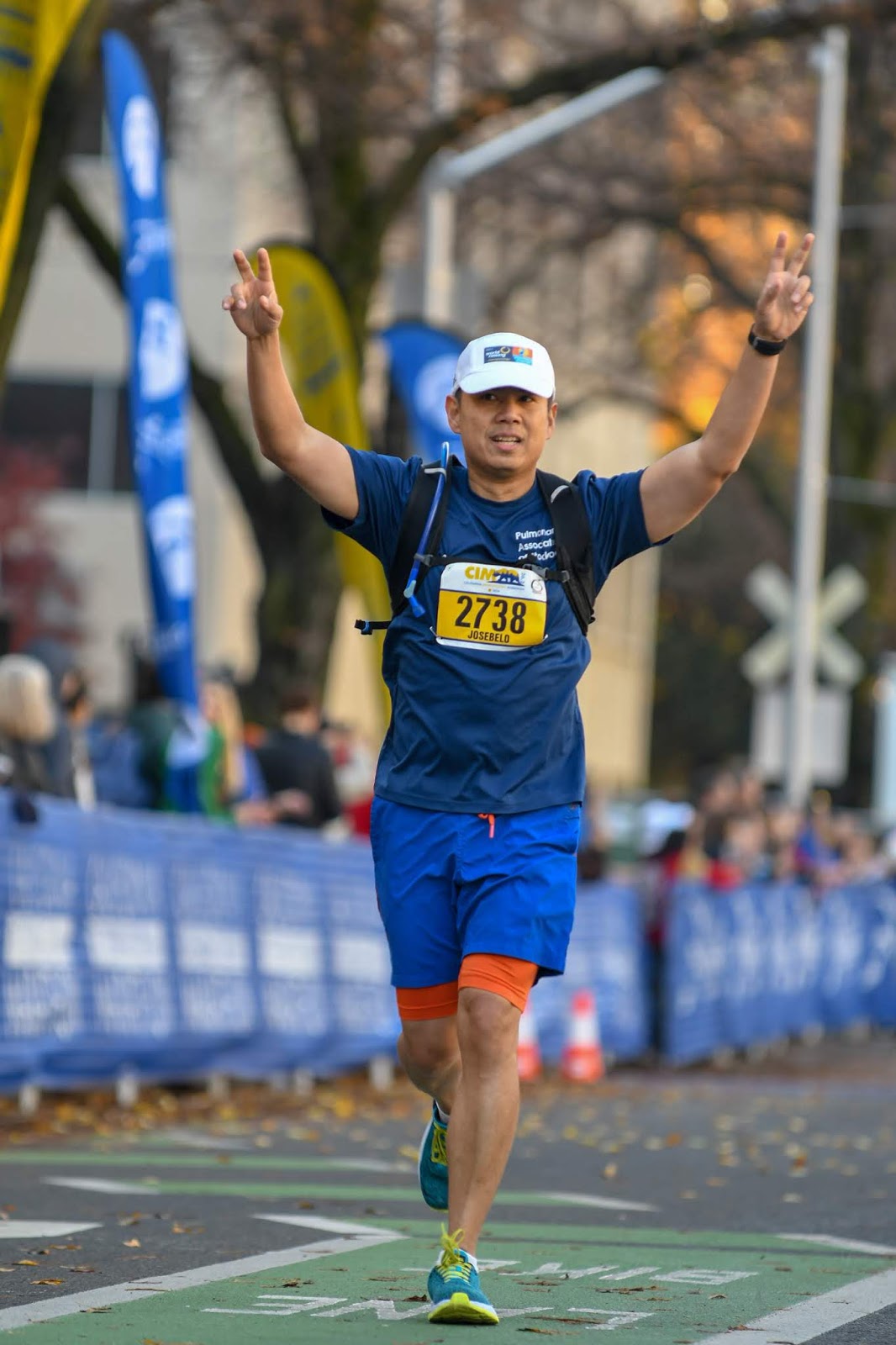
walking fast). I'd try to run for a couple of seconds at a time, but then my thigh would protest and threaten to explode, making me stop. I wondered if i'd be one of those runners who collapses mere feet from the end and drags themselves over the finish line (which, while dramatic, would ultimately be disappointing, since i didn't have a good backstory). Through sheer pigheadedness, i managed to run the final 0.1 and cross the finish line upright. But as soon as i did, both calves seized up and forced me to hobble through the chute. Done... and done.
 |
| Fake it 'til you make it! |
 |
| Photo credit: Images by Gia Chong |
In the final analysis, i realized that i had favored my right heel for the entire race. In trying to avoid exposing it to more impact, everything else - my left leg and all the other structures in my right foot that
weren't the heel - had been forced to work overtime. I had modified my foot strike to avoid landing on the painful spot, which changed my stride and made me run in a way that was unnatural for me. Retrospectively, i wonder if i did this during the Modesto Half as well. But that was only 13.1, and i was fine up until that point in this race. The full 26.2 (and beyond, i imagine) keeps you honest. Any and all training deficiencies, mental weaknesses, and niggling injuries will be laid bare and magnified as the miles pile on. In my case, i thought i could barrel through my whatever-the-hell-my-heel-problem-was. I was dead wrong.
I am - in a word - humbled. For the past year or so, i'd fancied myself some sort of athlete - picking up marathon running again in my 40s, accruing gains as the months went by. As i continued to work out, the pounds came off, and i looked/felt better than i have in close to a decade. In the 16 weeks leading up to Big Sur, i felt like i could do anything. Then reality paid me a visit and reminded me that i was doing something that i was never built to do. That hurt a lot, body and soul.
Meh.
Notes:
1. The expo was nothing special. Although, same as
New York and
CIM, they had a wall of names, which was cool.
2. Weather-wise, i've had a string of good luck with all my races. This one was no exception: temps in the high 40s to low 50s (reportedly milder than previous years) with zero precipitation. I was actually so concerned about the temperature at the start that i bought a headband just to cover my ears at the expo. It was much ado about nothing; it seems that my ears do just fine in the high 40s. The sky was overcast on race day, which was apparently a good thing because it meant that it wasn't going to be as windy as it could have been (i'm not clear on the meteorologic reasoning for this). On the other hand, i felt that the cloudiness diminished the majesty of the views; it would've been nice to see sunlight dancing off the Pacific Ocean.
3. The race started at 6:45-ish, but the last buses to the starting line (no drop-offs allowed) were scheduled to leave at 4:15. Meaning, you had to line up for transportation at 4 o'clock. In reality, our bus (the first one to leave our station) only got going at 4:30, so being tardy for the buses was probably not a tragedy. It took about an hour for the bus to get to the starting village from Carmel. Once there, there was an ample amount of porta-potties (according to the announcers, a "good" ratio of around 1 per 45 runners), and FOOD (!).
 |
| We were way more chipper than anyone should have to be at 4 in the morning. |
 |
| Waiting to get on the bus, around 4:15 AM. |
 |
| Arrived at the starting village around 5:30 AM. |
 |
| Got my pre-race bagel fix. |
4. The first few miles is mostly downhill, through some forested areas. It's easy to get carried away and run fast, but one should take care not to stress the quads before even getting to the hills.
 |
| Running through redwoods. |
 |
| 4,700 runners is not bad at all. |
5. You get out of the forest around mile 4. The views start getting really spectacular around miles 5-6.
 |
| Rolling hills at around mile 4. |
|
|
| You start to get a glimpse of the ocean at mile 5. It's there, i promise. |
 |
| Point Sur State Historic Park in the distance. |
6. Personally, i don't think BSIM is the time to attempt a PR. The course is gorgeous; one really needs to stop, soak it all in, and take as many pictures as possible. The views are what you came for; look for faster courses elsewhere. At the top of Hurricane Point, i had stop and take a
photosphere.
 |
| Looking north, from Hurricane Point. The ragged edge of the western world, indeed. |
 |
| The iconic Bixby Bridge in the distance. Everybody was taking pictures, and it was impossible not to get photobombed. |
 |
| Atop Bixby Bridge. |
 |
| Bixby Bridge from the other side. |
 |
| More photos of the ragged edge. |
 |
| The bagpipe lady at mile 15. |
7. Even though i feel like i did a halfway decent job of it, climbing up to Hurricane Point is a b!tch. While boning up on elevation charts prior to the race, i thought it would be a piece of cake. After all, New York was pretty hilly, too. What i DIDN'T take into account is that the elevation charts are not drawn to the same scale! New York's hills are little speedbumps, with the biggest climbs being "only" 100 feet. Big Sur is... a little more challenging.
 |
| Elevation chart from New York, in isolation. Looks hilly enough, yeah? |
 |
Elevation charts compared. (Cue the Crocodile Dundee voice going, "That's not a hill, THIS is a hill.")
Source: http://www.seerunlove.com/wp-content/uploads/2018/01/bsim-elevation-titled.png |
8. Another "feature" of the BSIM course is how steeply the roads are banked. While snaking their way around hills, the running surfaces are essentially diagonal. This can be torture to the ankles. In 2017, i paid the price for running along the side of the road too long at
B2B.
9. There's enough hydration, nutrition and porta-potties on the course. I had to stop to pee twice and didn't even get through my entire Camelbak.
 |
| There was a very short line at the mile 3 porta-potties. Farther down the course, there were no lines whatsoever. |
10. Due to time and weather constraints, the majority of my training is done on a treadmill (dreadmill). While i wouldn't recommend this to anyone, i personally don't have much of a choice. I paid special attention to hill training by increasing the incline for "hill days." Unfortunately, while this may be sufficient for the UPhills, there's no way to sufficiently train for the DOWNhills on a treadmill.
11. Prior to New York and Big Sur, we went on week-long vacations. The way i figured it, i should be tapering and carbo-loading on the week of the race anyway. This is probably a mistake, and i should leave the vacay for AFTER the race.
12. When i grow up, i want to be like
this guy. It'll probably never happen.
13. Next time we're in Carmel, we need to try this place:
 |
| No relation. |
So what comes next? Redemption? More disappointment? Only one way to find out. On to
Chicago!
 |
| To date, the hardest i've worked to get a finisher medal. |