June 11, 2020

Sourdough Chronicles: Loaf #2

The recipe was essentially unchanged from the previous one.  The only difference was the age of the starter.  Based on the Kitchn formula, it was "mature" enough, after 4 feedings.  I'm too much of a novice to independently verify that.  However, i CAN say that the starter immediately bubbles up after being fed with the 1:1 flour:water. 


Notes:

1. It smelled a bit like sourdough, but there was no significant amount of sour flavor.  I don't really mind, since my point to the starter is to homebrew a leavening - not a flavoring - agent. 

2. The air pockets seemed a little bigger this time around, which may be a consequence of the "mature" starter.  I'm still not satisfied with the way the lower half compresses. 

VERDICT: Still not good, but still edible. 

Next: Put it upside-down into the Dutch oven.

June 10, 2020

Sourdough Chronicles: Teenager-approved

Sourdough-Panko Zucchini Fries

Ingredients:

1 large zucchini
1 cup sourdough discard
2 (?) cups Panko breadcrumbs
Multiple twists of salt

Technique:

1. Cut zucchini open, scrape out seeds, slice into steak fries sized pieces.

2. Dunk zucchini slices into sourdough discard. 

3. Roll zucchini slices in Panko and salt mixture until coated.

4. Air-fry at 400 degrees for 7 minutes (parchment paper lining bottom). 

5. Serve while warm. 

I got lucky with this one, just pieced together a recipe from the internet. 

VERDICT: Adrian (while chewing his third piece): "It's very good."

Tomorrow, bread.

June 9, 2020

Sourdough Chronicles: It Begins

"Necessity is the mother of invention."
-Plato

Last Friday night - as i sometimes do - i mixed together some flour and salt to make a loaf of Saturday morning no-knead bread.  Unfortunately, when i rummaged around the back of the fridge, i realized that we were out of yeast.  The next day, we visited several grocery stores and realized (as many people had, months before), that EVERYBODY WAS OUT OF YEAST.   

I knew just from reading friends' recent Facebook posts that sourdough starter could serve as a suitable replacement for store-bought yeast.  I Googled some formulae and settled on one that seemed the easiest, from Kitchn.  Essentially: (4 oz flour + 4 oz water every 24 hours) x 4, keep at a constant temperature of 75-80 degrees.  

HOWEVER, i still had flour and salt sitting on the kitchen counter, waiting for some sort of leavening agent.  Last night, after 2 feedings, my starter already looked bubbly and smelled sour, so i decided to take the plunge and try to make no-knead bread with what i had.  

So, ingredients: 

3 cups unbleached flour
20 twists of kosher salt
Approximately 1 1/2 cups of purified water, room temperature, taken directly out of reverse osmosis tap  
1/2 cup of "sourdough starter discard"

Technique: 

1. At 9 PM: All ingredients were mixed together in a glass bowl.  The amount of water wasn't precise, i just added enough to make the dough "shaggy." 

2. At 6 AM: The "slightly risen" dough (this was disconcerting, i'm used to a more impressive rise overnight) was transferred to a lightly floured sheet of parchment paper, and folded once per side. 

3: At 630 AM: The dough looked a little flat, so i folded it again, once per side.  

4. At 715 AM: The parchment paper was lifted and plopped into the Dutch oven, which had been preheated to 450 degrees.  Baked/steamed for 30 minutes with the lid on.  

5. At 745 AM: The Dutch oven was uncovered. 

6. At 759 AM: The bread was removed from the Dutch oven, allowed to cool for 5 minutes, then eaten.  


Notes on the bread: 

1. It was a little flatter than i'm used to.  After cutting in half, i noted that the top had risen, and was "fluffy," while the bottom half was dense.  

2. The bottom was toasted, probably because of the density of the bottom half pushing down on it (?).

3. There was a slight sour taste, only noticeable if you thought about it.  

OVERALL VERDICT: Edible, but not good.  

Things to try: 

1. Use more "mature" starter.  Based on the Kitchn recipe, i needed two more feedings for it to mature completely. 

2. Dump the dough into the Dutch oven upside down, so the "risen" part gets pushed down a bit and the "flat" part gets a chance to rise - maybe this will lead to an overall fluffier loaf. 

3. Allow longer time for the dough to rise.  

4. Warm the water up in the microwave for about a minute before using. 

5. Add one early fold.

6. Change the proportion of ingredients: maybe just 2 1/2 cups of flour to 1/2 cup of starter. 

I'll bake another loaf after two feedings, we'll see what happens next. 

April 29, 2020

The Race that Never Was

This past March 1st, i did NOT run the Tokyo Marathon.  As with everything else, it was cancelled (at least for the general population).  This left a Japan-sized-and-shaped hole in my heart (and my wallet), which was only partially filled by Napa. 

At this point, they're saying that runners can choose to defer to either 2021 or 2022.  I will most likely select next year, once the deferral window opens.  Hopefully COVID will have blown over by then. 

Although i'm currently signed up for the TCS Amersterdam Marathon in October, i have significant doubts that it will push through.  I'll probably going to end up not even making arrangements, and just deferring to some future date once the deferral window opens.  If i get the opportunity to run another Abbott World Marathon Major next year, i'm going to do that instead. 

So i'm currently in limbo.  Fleet Feet has the "Running is Not Cancelled" virtual series that i'm thinking about signing up for.  Virtual racing is absolutely not the same.  On the upside, since the gym is closed, all my runs are done on the roads (thankfully, they haven't clamped down on outdoor exercise in our area), which i hope will reap dividends in terms of my strength and endurance.  Usually, the bulk of my training is done on the forgiving surface of the treadmill.  My Achilles can tell the difference, that's for sure.  Hopefully there's long-term benefits as well. 


March 3, 2020

4:34:38 (AKA It's Not Tokyo But It'll Do)

This past weekend, i was supposed to run the Tokyo Marathon.  Instead, i completed the Napa Valley Marathon in 4:34:38.


The cancellation of the Tokyo Marathon hurt... my soul, and especially my wallet.  But i understood why.  COVID-19, outbreak containment, etc, made sense to me.  So it rubbed salt in the wound when the virus made its way to California anyway, even before March 1st.  Meh.  In the end, i am nothing if not pragmatic, so i just rolled with it and found another marathon on the same date.

I have to say though - that aside from running it 5000 miles from where i originally intended - this marathon was everything i wanted it do be.  I had hit almost all my target mileage and paces in the 16 weeks leading up to the race, i had a good game plan, i was close to my goal BMI - overall, the best prepared i've been in ANY of my previous marathons (including my very first one a little over 9 years ago).  I had a sinking feeling in the pit of my stomach (irrational) that i was going to disappoint myself the way i had in my last two races, but knew that there wasn't anything else to do but trust my training.

The much sought-after running photo where both feet are actually off the ground!

It seems that the trust was well-placed.  The run-walk-run method continues to reap benefits for me.  Previously, i would extend the running intervals on downhills or if i was feeling particularly good.  This time, i did not deviate from my 3:1 ratio at all.  On the running intervals i would do somewhere between a 9:00 and 9:30, then dial it down to a 17-ish for the walk.  I'm not sure i can run much faster and still be comfortable, so maybe i need to learn how to walk faster if i want to break 4:30.  Honestly though - around mile 16, i realized that i had an actual shot at breaking 4:30 if i hit an average pace of around 9:50-10:00.  That would have meant skipping some walk breaks, which could be disastrous.  Reminding myself that the goal was to stay injury-free, not hit some arbitrary time goal, i stuck with the game plan, did a negative split (!), and finished 20 minutes faster than Chicago - 16 minutes faster than CIM.

The tectonic shift that i did in preparation for this race was to almost completely eliminate the consumption of Gu during my training runs.  I used to go through one packet every 4 miles or 45 minutes (whichever was sooner).  Occasionally i'd get away with six miles, especially during "speedwork," but without fail i'd need a Gu at some point or else i would just bonk.  On a long run of 22 miles, i would go through five packets.  Well, i read on some rando site (Runners' World?  Reddit?  I forget) that one isn't supposed to eat during a long run.  Apparently, the WHOLE POINT of the long run is to train one's body to run on fat, not carbs.  So i cut out the Gu on the premise of teaching my body to run on different fuel, and worked my way up to 16 miles on just water before bonking.  Then, for the actual race, i consumed Gu the way i used to.  It was, in a word, amazing.  Each time i ingested the gel, i would feel stronger: a sensation of WOW, THIS IS GREAT! as opposed to THANK GOD I ATE SOMETHING OR ELSE I WOULD DIE.  In my last 5 marathons, non-running areas such as my shoulders and arms would cramp and go sore (mayhap glycogen was being cannibalized everywhere just to feed the legs), but for this run everything felt great all the way to the end.  So, for future reference: continue to subsist on minimal external fuel while training, but find the optimal ratio/timing for race day.  Perhaps every 3 miles (or 30 minutes) instead?   I'll try that out on a half.

Close to the finish - still going strong!

Hanging loose as i crossed the finish line.

Another thing i changed for this race - i changed my footwear from the Hoka Mach to the Nike Pegasus 36.  More on this in the future. 

In sum - i'm happy with the way this went. 

Race Notes:

1.  The expo was nothing to write home about.  We were in and out in about 15 minutes, including packet pick up and looking at exhibits/merchandise.  They gave out a decent backpack with the usual snacks, KT tape, etc.

2.  Temperatures, as usual for me, were perfect.  We started out in the mid 40s (warm enough to discard all my Goodwill clothes even before crossing the starting line) and ended up in the low 60s.  There was a moment at the start when it started to drizzle, but that quickly stopped and it was clear/sunny for the remainder.

3.  Bus rides from pickup points in Napa (where the finish line is) to Calistoga (where the race starts) are nice and convenient.  In addition, they let you stay in the warm bus until about a half hour before the gun goes off - ample time to hit a porta potty (i only spent about 15 minutes in line for one).   No food or water available for non-VIPs at the start... Good thing i had a full Camelbak and some bread to munch on.

The lines for the porta-potties.  Not bad.

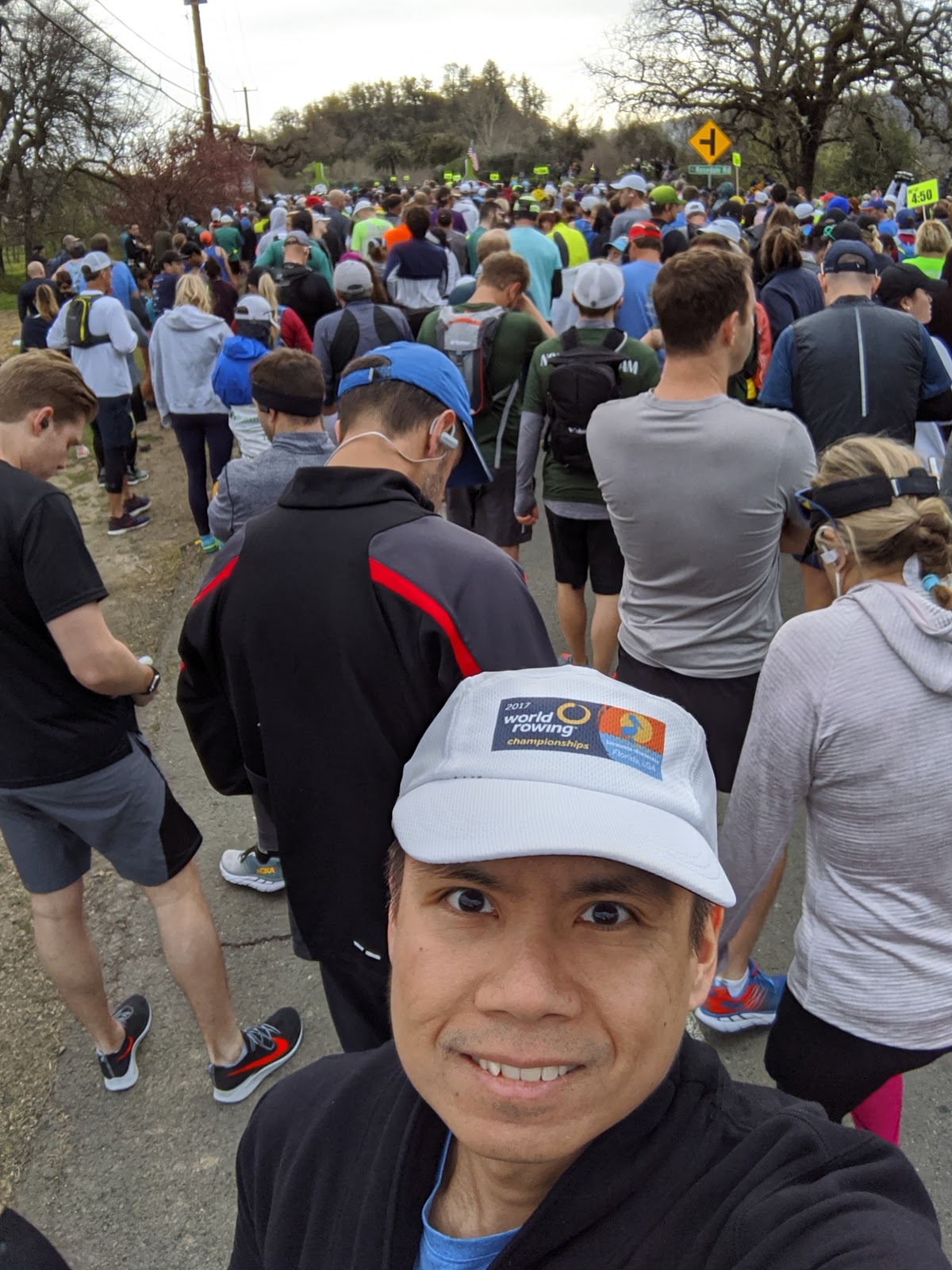
4.  I am really beginning to prefer the smaller races.  There were only a little over 2000 marathon runners, which is a tiny fraction of the field for New York and Chicago.  I did not have to weave around other runners (despite there being only one self-seeded wave) and was somewhat able to run the tangents, which resulted in me running only a wee bit over 26.2.  On multiple occasions, i found myself running alone, which i honestly consider to be pleasant.  Unfortunately, since i DO want to finish the World Marathon Majors at some point, i guess i'll have to contend with a gigantic field at least 4 more times.

At the starting line.  I was about halfway into the crowd.

5.  The course, which runs south on the Silverado Trail, is GORGEOUS.  IMHO, almost as pretty as Big Sur, without the coastline.  Mountains on both sides, with one vineyard and winery after another.  Not many spectators, which is fine by me (one can only laugh at a sign that goes "You run better than the government" so many times).  While advertised as being net downhill, there were several rolling hills in the first two-thirds.  Nothing compared to Big Sur, but certainly not flat (at least not until the last 6 miles or so).  There was sufficient support on the course, with aid stations supplying water and electrolytes every two miles or so.  There were porta potties at every aid station, and the lines were never more than two deep.  People actually stopped using them around midway through the course, and i was lucky enough to waste very little time dashing into a line-less one at around mile 12. 

Nice, picturesque backdrop. 

6.  There wasn't really much of a post-race experience that i noticed.  There was the usual medal, water, and food.  The most important post-race experience to me is how to reconnect with family and get back to my hotel.  In this, the small field continued to be a Godsend.  Gianina and Adrian were waiting right at the finish line, and the car was parked just a couple of hundred feet away. 


7.  The race entry includes some free wine tastings with "partner" wineries.  Since i'm not a big drinker, i didn't avail of any.  Still, a nice perk for some. 

So that's it.  At this point, 7 marathons in, i think i've figured out a method that works.  Now, to grind.  I haven't quite decided on my next race yet, but i'm cautiously optimistic that things are looking up.

We just pretended to be in Tokyo by hitting a conveyor belt sushi buffet.


October 30, 2019

The Dugyot From Way Back

Since early high school, i've been One Who Writes.  Not well, nor prolifically, but enough to make my thoughts known and make ME happy.  In 2005, i discovered blogging and became an avid blogger on the website doktorko.com.  Shortly after that, i made the jump to a website called vox.com.  Over the years, i generated over a hundred blogposts.  In 2010, after turning into a Google fanboy, i decided to move to blogger.com.

Alas, shortly after i moved to blogger, both doktorko and vox shut down, taking all my posts with them.  Unfortunately, even though i had multiple opportunities to migrate/save my data, i procrastinated until they eventually ended up in oblivion.  Years of writing, gone JUST LIKE THAT.

I grieved over the loss.  In my opinion, i had written some pretty decent posts over the years, but they were never to be seen again.

Recently though, i discovered the Wayback Machine.  I had no idea such a thing even existed, but apparently it's archived the internet over the past few decades.  I dared to hope that it archived doktorko and vox, and gingerly typed in my vaguely-remembered URLs for my blogs.

I am happy to report that i achieved SUCCESS!  While i wasn't able to save everything, i was able to extract 96 blogposts from those two sites.  I copied and pasted the content into my "new" blog - Dugyot From Way Back (the observant reader will note that the URL is completely different... that's because the initial iteration of this blogsite was supposed to be entitled "The Rhythm Strip," but i eventually decided that "Dugyot" was more apropos).

I realize that nobody really cares, but i am extremely glad/grateful/ecstatic that i was able to resurrect some old "gems" like The Animal Story, the Medical Miseducation series, and the Turista series.

Since the initial blogposts were written "op-ed" style, i feel like it would be best to present them in chronological (oldest to newest) order.  Many of the links are broken, and i was unable to recreate the images and videos on the original sites, but at least the content is still there, and i hope the omissions don't detract too much from the overall experience. 

After i read through the posts, i realized - much to my dismay - that i have mutated from an idealogue to a pragmatist.  Honestly this made me sad and a little bit angry.  I feel/hope that the idealist in me is still there somewhere and comes back out once life settles down a little bit more (no further details forthcoming).

October 29, 2019

4:55:42

So two weekends ago, a day after the venerable Eliud Kipchoge broke the 2-hour barrier for the marathon, i finished the Bank of America Chicago Marathon in 4:55:42.


My time was nothing to write home about.  After finishing last year's CIM in 4:52 and change, i really thought i could come in between 4:30 and 4:45.  In fact, early in the race, i was convinced that i could do it.  As usual, i run-walked with a 3:1 ratio.  The plan was to do the first few miles a little slow, then find a decent rhythm 4-6 miles in.  After the first half, i would start accelerating and lock in a "fast" pace until mile 20, then just completely run the remaining 6.2 miles at a "tempo" pace.  Done properly, this would get me in around 4:30, with 4:45 as a worst case scenario.

Half the race was actually run "according to plan."  Unfortunately, around 13-15 miles in (yes, that early), i felt the beginnings of a cramp in both my calves.  Not full blown contractions, but enough tension to let me know that they would start seizing up if i asked too much of them.  It was enough to make me consciously heel-strike; apparently when my cadence goes up to 160-180, i start midfoot-striking, which my calves object to.   At that point, i dared not increase the pace, for fear of demolishing my calves.

Slowly picked up the pace until the halfway point, then had to dial it back down.

Running with trepidation. 

A little over 21 miles in, i had a half-second cramp in my right calf during a running interval.  It dissipated quickly, but forced me to slow down even more.  Eventually, everything fell apart in the final 0.2.  There was the tiniest bit of an incline on that last right turn heading into Grant Park.  Not much, but enough to make me extend my walking interval by another 30 seconds or so.  Since i wanted to finish running, i picked my feet up and RAN once it started flattening out.  But then, literally ONE FOOT from the finish line, it happened: both my calves completely seized up, forcing me to ignobly hobble my way to 4:55:42.

Everyone else was happy to finish... I was disgusted with myself.

So - i was not happy.  But (as if i had a choice) i'll take it.  As far as the Abbott World Marathon Majors are concerned... still five minutes faster than my last one.

As an excuse for my performance, i am invoking undertraining.  I don't think i prepared enough for this race.  In my training leading up to NYC/CIM and Big Sur, i ran about 560 miles over 15 weeks.  In contrast, i only ran 460 miles (a 20% difference) for Chicago.  This was done on purpose: after developing plantar fasciitis (diagnosis made by legit podiatrist) around Big Sur, i made a conscious decision to run less this time around.  It worked - the heel pain let up after a few weeks, and i didn't feel as bad in the month leading up to the big race as i did previously.  In that context, i should be GRATEFUL that i even got to run another marathon this year (or ever!).  So: slower, but - literally - at least i made it.

Hopefully, i'll be able to do around 500 miles for the next buildup, run the actual race faster, and still remain healthy.  Only one way to find out.


Race notes:

1.  The expo was well-organized, but otherwise unremarkable.  Packet pickup was a breeze.  Note that even though they don't include safety pins with the bib, they're available "Participant Services" close to the entrance.  There was no wall of names.

Waiting in line to get into the expo.

2.  The weather on race day was a little chillier than i'd prefer, staying in the low 40s for the duration of the race.  Coupled with the wind chill factor in the "Windy City," it got pretty nippy.  The wind also threatened to blow off my cap a lot of times, which i remedied simply by riding the visor low.  I honestly don't mind the cold when running...  Undoubtedly better than that year when it almost went up to the 90s.  My regular outfit was still sufficient coverage.

The mass of humanity waiting at the start.  Temperature: 42 Fahrenheit.

I had to keep the brim pointed down to stop my cap from blowing off.

3.  The entrances/gates to the corrals are located on Michigan Street, starting at around the corner of Monroe and extending all the way down to Balbo.  The roads are closed on Lakeshore Drive.  We found this out the hard way, when our Uber driver opted to drop us off at Balbo and Lakeshore in order to avoid the crowds on Michigan.  We had to walk quite a ways just to get to the right spot.

Close to the starting line.  I had already walked about a mile, at this point. 

4.  The Balbo Hospitality Tent is a spacious, heated tent with buffet breakfast and lunch (for after the race), unlimited fluids, a charging station, and post-race massages.  They also had their own gear check, separate from the other 45,000 runners.  There were more than enough porta-potties.  Whether this is worth $125 or not is completely up to you.

Pre-race buffet breakfast.  They had sandwiches.

Enjoying a cup of coffee before the race.

The post-race spread.

5.  The course is not COMPLETELY flat (it's not on a track, after all), but there's no significant up- or downhills.  There was a gentle upslope at the end that i only really noticed because of my cramps.

6.  On-course, it seemed to be much less crowded compared to NYC.  My heels weren't kicked as much nor did i feel like i had to navigate through a crowd whenever i tried to move to the side of the road to walk.  Personally, i felt that NYC was overwhelming in terms of crowds (participants and spectators both).  Chicago was STILL thousands of people, but less crowded.

There was always a crowd, but not too bad IMHO.

7.  The post-race experience is a lot better than NYC.  The family reunion area is relatively close to the finish; no need to climb an overpass to get there.  Unfortunately, unlike NYC, there was no sweet poncho at the end.  They DID however have that special 312 beer with an additional Goose Island beer that you can redeem with the coupon that comes with the bib.  For some reason, they wouldn't let people take the cans of beer (even when demonstrably empty) out of the marathon finisher area, which defeats the purpose of having a "souvenir" beer can. 

Reunited with my support crew.

"Free" beer.


8.  I think the Abbott World Marathon Majors is nothing more than a genius marketing ploy.  I'm not really out to garner "six stars," but i may get them while working through my "marathon bucket list."  To be honest, i haven't been highly impressed by the courses for either Chicago or NYC.  While the cities they're held in are great and the organization is stellar, i wish the actual courses were more picturesque and actually worth running through.  Not every course can be as gorgeous as Highway 1, but if Chicago had run up Lakeshore Drive or at least up Magnificent Mile, it might have been more interesting.

Who cares about the medal?  The deep dish pizza is the real reward in Chicago! 

9.  Even though my calves ultimately betrayed me, i never came close to "hitting the wall."  So the problem was not necessarily one of nutrition or hydration.  Or perhaps it was?  At one point, when i reached back to put my water bottle in my belt, my left shoulder started cramping.  I may have been so depleted that ANY muscle ANYWHERE would cramp with exertion.  Nutrition-wise, i went through six Gu packets (one every 40 minutes or so).  Hydration-wise, i drank at every station (i believe there were twenty in all).  However, i barely drank from my own water bottle, and didn't pee for close to 4 hours after the race finished.  So maybe it WAS dehydration...?  On a slightly related note, my Vaporkrar flexible bottle keeps digging into my back; maybe i need a better way to carry my water when Camelbaks aren't allowed.  Regardless, one thing i probably need to focus on is strength training for my calves.

10.  While my Garmin tells me that did 26.2 at around 4:45, the official "tale of the tape" says otherwise.  With so many runners on the course, it's impossible to run the tangents properly (which is why the elites start way before us regular folk), which resulted in me running a 27.05 mile marathon.  Meh.

More lessons learned.  Onward to Tokyo!